
France is home to some of the most extraordinary castles and châteaux in the world. From grand Renaissance palaces along the Loire to imposing medieval fortresses in the south, these architectural treasures tell the story of French kings, queens and some of history’s most colourful characters.
Having lived in France for over a decade – first near Tours in the heart of the Loire Valley and later in Paris – I was lucky enough to visit many of these castles first-hand. Our time living close to the Loire meant that château visits became a regular weekend activity, and Loire Valley locals often told us you could visit a different castle every weekend for years without running out. It’s no exaggeration.
In this guide, I’m sharing our pick of the 25 most beautiful castles in France, organised by region to help you plan your trip. Some are medieval, some date from the Renaissance, and one is actually being built right now. Whether you’re planning a self-guided tour of France or a dedicated château road trip, these are the ones not to miss.

Best Loire Valley Castles
The Loire Valley is often called the “Garden of France” and is rightly famous for its concentration of stunning châteaux. A UNESCO World Heritage Site, this region stretching from Orléans to Angers was the playground of French royalty for centuries. During our years living near Tours, we explored dozens of these castles and the ones below consistently stood out as the most impressive.
1. Château de Chenonceau
The Château de Chenonceau is my personal favourite and arguably the most beautiful castle in France. Famous for its breathtaking position spanning the river Cher, this iconic Loire Valley château has a history shaped almost entirely by remarkable women.
Built by Henry II as a gift for his mistress Diane de Poitiers, the castle was completed in 1522. When Henry II died, Queen Catherine de Medici took over Chenonceau and forced Diane to move to Chaumont Castle. Catherine added the spectacular gallery bridge that gives the château its signature silhouette.
Chenonceau has some fine Renaissance furniture, antique tapestries and paintings by Rubens and Le Tintoret. It is the second most visited French castle after Versailles, attracting over 1.3 million visitors each year. We’ve been there several times and are blown away by its beauty each time.
Highlights:
- Iconic arched gallery spanning the river Cher – one of the most photographed castles in France
- Rich history tied to powerful women including Diane de Poitiers and Catherine de Medici
- Beautiful formal gardens, flower arrangements that are changed weekly, and a hedge maze
- Fine Renaissance art collection with works by Rubens and Le Tintoret
- Purchase Chenonceau tickets in advance during high season as queues can be very long

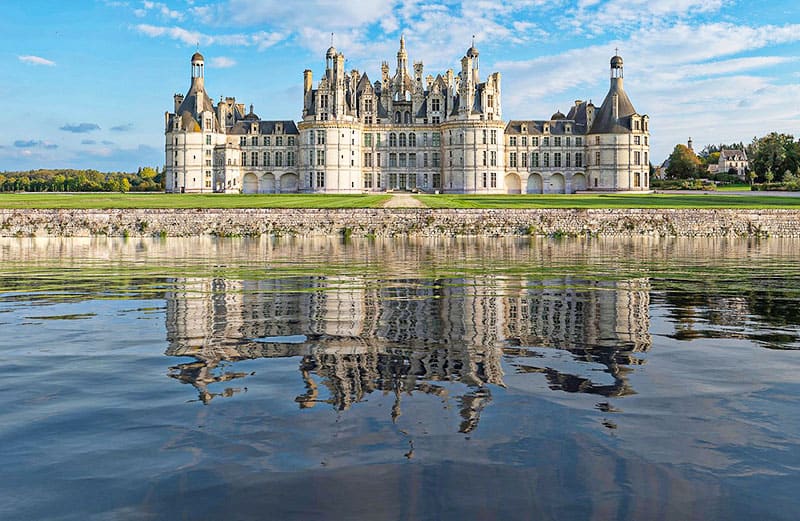
2. Château de Chambord
A former hunting lodge of King Francis I, Chambord is a magnificent Renaissance castle and one of the most famous landmarks in France. It is particularly well known for its double helix staircase, widely attributed to Leonardo da Vinci. You can walk up one section without seeing anyone walking down the other.
The largest castle in the Loire Valley, Chambord has 426 rooms, of which 60 are normally open to the public. Keep an eye out for the carved salamanders, the emblem of Francis I. There are 5,440 hectares of gardens, making Chambord the largest enclosed park in Europe.
Highlights:
- Famous double helix staircase, believed to be designed by Leonardo da Vinci
- 426 rooms, 282 fireplaces and 84 staircases in total
- Largest enclosed park in Europe at 5,440 hectares
- Renaissance rooftop terrace with panoramic views of the grounds
- Get a Skip the Line ticket to beat the summer rush
3. Château Royal de Blois
The Royal Château de Blois is located in the centre of Blois, an attractive city in the Loire Valley. This famous French monument is unique in featuring four different architectural styles in one building.
There’s a medieval fortress, Louis XII Gothic wing, Duke of Orleans wing and François I Renaissance wing. When we visited the castle, it was the latter’s ornate corkscrew staircase that really stood out. Ten queens and seven kings lived in Blois Castle over the years, and the Duke of Guise was famously assassinated here in 1588 on the orders of King Henry III.
Highlights:
- Four distinct architectural styles from medieval to Renaissance in a single castle
- Spectacular François I Renaissance staircase – an architectural masterpiece
- Scene of the dramatic assassination of the Duke of Guise in 1588
- Summer Sound and Light show (included with advance entry ticket, subject to dates)
- Located in the heart of Blois, making it easy to combine with lunch in town

4. Château de Villandry
Known for its breathtaking gardens, Villandry is a Renaissance palace that any garden lover will adore. Owned by Henri Carvallo, great-grandson of former owners Joachim Carvallo and Ann Coleman, the castle has been carefully restored to its former glory. If you love gardens, also check out our guide to the most beautiful gardens in the world.
The ornamental kitchen garden is Villandry’s crowning glory – a geometric marvel of vegetables, herbs and flowers arranged in decorative patterns. There are also some interesting additions such as a herb garden and Sun Garden.
Highlights:
- France’s most famous ornamental kitchen garden with stunning geometric patterns
- Six distinct themed gardens including the Garden of Love and Water Garden
- Renaissance château with period-furnished rooms
- Beautiful views from the castle’s upper terrace over the gardens and Cher Valley
- Buy an advance ticket to Villandry Castle and gardens to skip the queues

5. Château du Clos Lucé
The former home of Leonardo da Vinci, le Clos Lucé is a large château in the town of Amboise in the Loire Valley. Leonardo came to Amboise as the guest of King Francis I in 1516 and spent the final three years of his life here, passing away in 1519.
As Leonardo once said, “details make perfection and perfection isn’t just a detail.” That’s certainly true of Clos Lucé Castle, which has been lovingly restored. There’s a copy of the Mona Lisa made by Ambroise Dubois in 1654 and 40 models of the maestro’s inventions. In the Leonardo da Vinci park, reproductions of 40 of his paintings are suspended from trees.
Highlights:
- Leonardo da Vinci’s final residence, where he lived from 1516 to 1519
- Connected to the Château d’Amboise by an underground tunnel used by King Francis I
- 40 scale models of Leonardo’s inventions and interactive displays
- Outdoor park with life-size reproductions of his machines
- Buy a Skip the Line ticket to beat the summer rush

6. Château d’Amboise
The Royal Château of Amboise has a lovely setting overlooking the banks of the river Loire. A residence of French kings from the 15th to the 19th centuries, Amboise Castle is now owned by the Fondation Saint-Louis.
King Charles VIII was instrumental in shaping much of the castle that we see today. His keen interest in Renaissance architecture led him to reconstruct Amboise with the help of Italian artisans. You can spot Charles’s monogram, a flaming sword, and Queen Anne of Brittany’s ermine tails in several of the castle rooms.
Highlights:
- Commanding position overlooking the Loire with panoramic river views
- Chapel of Saint-Hubert, believed to be the final resting place of Leonardo da Vinci
- Beautifully landscaped Mediterranean and Oriental-inspired gardens
- The castle hosted some of the earliest Italian Renaissance influences in France
- Consider buying a Skip the Line ticket if visiting in high season

7. Château de Cheverny
Fans of the Tintin comics may recognise Cheverny Castle from the books – it was the inspiration for Marlinspike, Captain Haddock’s country estate. Out of all the French châteaux that we’ve visited, this is one of our favourites.
Cheverny is still fully furnished and privately owned by the de Vibraye family, which gives it a wonderfully lived-in feel quite different from the state-owned châteaux. Inside there’s an interactive Tintin exhibition as well as a beautiful 17th century Gobelin tapestry and a Louis XIV chest of drawers.
Highlights:
- Inspiration for Marlinspike Hall in the Tintin comics, with a dedicated Tintin exhibition
- Still privately owned and fully furnished, offering a glimpse of aristocratic life
- Magnificent 17th century Gobelin tapestries and period furniture
- English-style park, Garden of Love, bay tree maze and Tulip Garden
- Don’t miss the dog kennels – Cheverny is still a working hunting estate

8. Château d’Azay-Le-Rideau
A fine example of early French Renaissance architecture, the castle of Azay-Le-Rideau stands on an island in the river Indre. This beautiful place was built in the 16th century, with the turrets being added in the 19th century.
Originally the home of Gilles Berthelot, the Mayor of Tours and Treasurer of François I, the château was confiscated by the king who felt the extravagant castle was proof of embezzlement. When we visited Azay-le-Rideau, we particularly liked the gardens – one of the former owners, Charles de Biencourt, was a botany enthusiast who planted sequoia, cedar and American tulip trees.
Highlights:
- Romantic island setting on the river Indre with beautiful water reflections
- One of the finest examples of early French Renaissance architecture
- Landscaped park with rare trees including sequoia and American tulip trees
- Recently restored interiors with multimedia displays bringing the history to life
- Smaller and less crowded than Chenonceau or Chambord – get an advance ticket to skip the queues

9. Château d’Ussé
Often called the Sleeping Beauty Castle, Château d’Ussé is said to have inspired Charles Perrault when he wrote his famous fairy tale. With its white turrets rising above the forest of Chinon and facing the Indre Valley, it’s easy to see why.
This enchanting castle dates back to the 11th century and sits on the edge of the Chinon forest. Inside, you’ll find lavish 17th century furnishings, fine tapestries and a charming recreation of the Sleeping Beauty story told through costumed mannequins in the tower rooms. The terraced gardens were designed by André Le Nôtre, the landscape architect behind the gardens at Versailles.
Highlights:
- Inspiration for Charles Perrault’s Sleeping Beauty – a true fairy-tale castle
- Stunning white turrets against a backdrop of the dark Chinon forest
- Terraced gardens designed by Le Nôtre with ornamental lakes and an orangery
- Costumed mannequin displays in the towers retelling the Sleeping Beauty story
- A favourite with families and one of the most photogenic châteaux in the Loire

10. Château de Saumur
Perched dramatically on a hilltop overlooking the Loire and the pretty town below, the Château de Saumur looks as though it has been lifted straight from a medieval manuscript. Its elegant octagonal towers and white stone walls make it one of the most photogenic castles in the Loire Valley.
Originally built as a fortress in the 10th century, Saumur has served as a military stronghold, a prison and a governor’s residence over the centuries. Today it houses a museum of decorative arts and an equestrian museum, fitting for a town famous for its horse riding school, the Cadre Noir.
Highlights:
- Fairy-tale hilltop silhouette visible from across the Loire Valley
- Home to the Musée du Château with decorative arts and equestrian collections
- Saumur is also famous for its Cadre Noir riding school and sparkling wine cellars
- Sweeping panoramic views from the castle ramparts over the town and river
- Combine with a visit to the nearby troglodyte caves and wine producers

11. Château d’Angers
The Château d’Angers is a mighty medieval fortress with 17 massive striped towers constructed from dark schist and white limestone. Built in the 13th century by Blanche of Castile for her son Louis IX (Saint Louis), it represents some of the finest military architecture in France.
The castle’s star attraction is the extraordinary Apocalypse Tapestry – the largest surviving medieval tapestry in the world. Commissioned in 1375 by Louis I of Anjou, this remarkable work was originally 140 metres long and depicts the Book of Revelation in vivid detail. The beautifully redesigned gardens within the fortress walls are also well worth exploring.
Highlights:
- Home to the Apocalypse Tapestry – the world’s largest surviving medieval tapestry at 100+ metres
- 17 imposing towers of striped dark schist and white limestone
- Beautiful redesigned formal gardens within the fortress walls
- Free guided tours available, plus affordable audio guides
- Located in the attractive city of Angers, an ideal base for exploring the western Loire

Best Castles Near Paris
Some of France’s grandest palaces are within easy reach of the capital, making them perfect for day trips. During my time living in Paris, these were among our favourite excursions, and each one offers something quite different from the others.
12. Château de Versailles
No list of French castles would be complete without Versailles. This historic monument was the main royal residence in France from 1682 to 1789. King Louis XIII built a hunting lodge on the grounds, which his son Louis XIV rebuilt and extended into the enormous palace we know today.
The 70-metre-long Hall of Mirrors, completed in 1689, is the undeniable highlight. It features 357 mirrors, glass chandeliers and an ornate ceiling painted by Le Brun. Outside, the gardens designed by André Le Nôtre include elaborate fountains and the charming Petit Trianon estate where Marie Antoinette retreated from court life. If you enjoy exploring hidden gems in Paris, Versailles makes an excellent day trip.
Highlights:
- The magnificent 70-metre Hall of Mirrors with 357 mirrors and painted ceiling
- Sprawling formal gardens designed by Le Nôtre with musical fountain shows in season
- Marie Antoinette’s Petit Trianon and rustic Hameau de la Reine
- The most visited château in France – advance booking is essential
- Allow a full day for your visit; we suggest arriving early to avoid the worst crowds

13. Château de Fontainebleau
One of the most famous castles in France, Fontainebleau is located 34 miles from Paris. This grand palace is one of the largest royal châteaux in France and was a favourite dwelling of monarchs from Henri II to Napoleon Bonaparte.
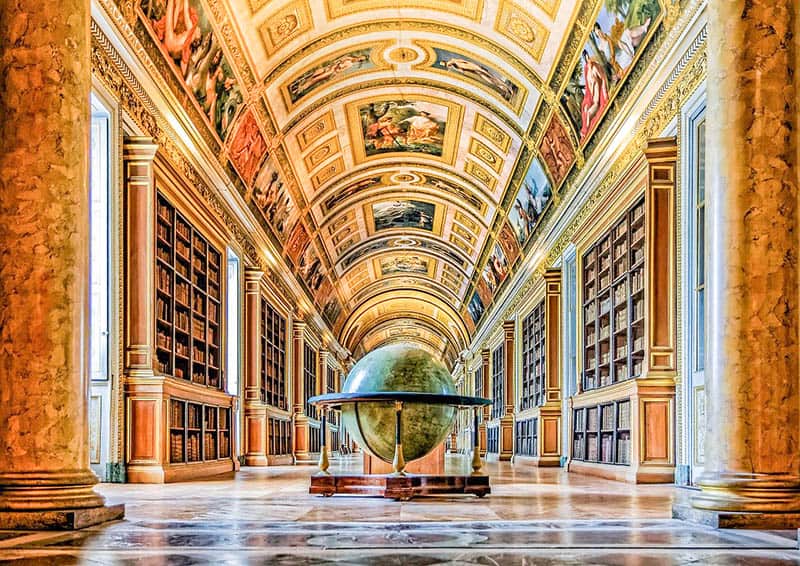
From 1528, the Renaissance movement flourished here as the School of Fontainebleau. The Gallery of Diana, an 80-metre-long corridor lined with books, is particularly striking – don’t miss the large globe that came from Napoleon’s office in the Tuileries Palace. The Palace and Park of Fontainebleau is a UNESCO World Heritage Site.
Highlights:
- One of the largest French royal châteaux, with over 1,500 rooms
- The stunning Gallery of Diana – 80 metres of book-lined elegance
- Napoleon’s private apartments and the famous horseshoe staircase where he bid farewell to his troops
- Extensive grounds including a carp pond, English garden and Grand Parterre
- Purchase a priority entrance ticket to skip the queues
14. Château de Chantilly
One of the most beautiful castles in France, Chantilly boasts the second largest collection of antique paintings in France after the Louvre. Henri d’Orléans was a keen collector of manuscripts and artworks, and the Reading Room designed by architect Honoré Daumet houses the duke’s rare book collection.
Chantilly Palace is also known for its Great Stables, built by the 7th Prince of Condé. Now housing the Museum of the Horse, these are the largest stables in Europe. The Chantilly estate also includes beautiful gardens designed by Le Nôtre and a charming hamlet that inspired Marie Antoinette’s at Versailles.
Highlights:
- Second largest collection of old master paintings in France after the Louvre
- The Great Stables – the largest in Europe, now home to the Museum of the Horse
- Formal French gardens by Le Nôtre and an English landscape garden
- The Hameau, a rustic village that inspired Marie Antoinette’s at Versailles
- Buy a Skip the Line ticket in advance if visiting during summer

15. Château de Vaux-le-Vicomte
Vaux-le-Vicomte is a masterpiece of Baroque architecture located in Maincy, Seine-et-Marne. Designed by Louis Le Vau in 1656, the castle was commissioned by Nicolas Fouquet, King Louis XIV’s Finance Minister. However, irregularities in Fouquet’s accounts were found and he was sentenced to life imprisonment.
The story goes that Louis XIV was so jealous of Vaux-le-Vicomte’s splendour that it inspired him to build Versailles using the same team of architects. Today, the castle is decorated as if Fouquet had just left. The candlelit evening visits held on Saturday evenings during summer are magical.
Highlights:
- The Baroque masterpiece that inspired the construction of Versailles
- Beautifully preserved interiors presented as if Fouquet had just left
- Stunning formal gardens designed by Le Nôtre
- Candlelit evening visits on summer Saturday nights (not to be missed)
- Don’t miss the Carriage Museum in the stables – get an advance ticket with audio guide to skip the queues

16. Château de Malmaison
This famous French château is situated 9 miles from Paris, in Rueil-Malmaison. The former home of Napoleon Bonaparte and Joséphine from 1799 to 1814, Malmaison was built in the 17th century.
It was Joséphine who found the land and took an active role in planning the gardens. She favoured the naturalistic English landscaping style, together with black swans from Australia which became her emblem. These days, black swans have been reintroduced to the gardens and Malmaison is a national museum-château.
Highlights:
- Former home of Napoleon and Joséphine Bonaparte, beautifully preserved
- Joséphine’s English-style gardens with her signature black swans
- Intimate scale compared to Versailles, offering a more personal glimpse of Napoleonic life
- Excellent collection of Empire-period furniture, art and personal belongings
- Easy to reach from central Paris by RER train

17. Château de Maintenon
This elegant castle in Eure-et-Loir is famous as the private residence of the second wife of Louis XIV, Madame de Maintenon. As they married in secret, she was the unofficial Queen of France.
The castle has beautiful gardens created by André Le Nôtre in 1681. At the end of the gardens, there’s an impressive aqueduct designed by Vauban to carry water from the Eure River to the fountains of Versailles – it was never completed, but the ruins are spectacular.
Highlights:
- Home of Louis XIV’s secret wife, the unofficial Queen of France
- Formal gardens designed by Le Nôtre with an unfinished Vauban aqueduct as a dramatic backdrop
- Less visited than the major Loire châteaux, offering a peaceful experience
- Charming town of Maintenon with riverside walks
- Just over an hour from Paris by car, easily combined with Chartres Cathedral

Best Castles in the South of France
The south of France offers a completely different flavour of castle – think imposing medieval fortresses, Cathar strongholds and Gothic palaces. During our travels through the Languedoc region and Provence, we discovered some truly dramatic sites that feel a world away from the refined elegance of the Loire.
18. Cité de Carcassonne & Château Comtal
The Cité de Carcassonne is a magnificent medieval fortress perched atop a hill in the Languedoc region of southern France and is a true marvel of military architecture. Dating back to the Gallo-Roman period, the citadel’s imposing double walls, 52 fortified towers and intricate system of defence have withstood the test of time.
Within the walled city, the Château Comtal is an imposing fortified castle restored by renowned architect Eugène Viollet-le-Duc in 1853. We spent a whole day here walking the ramparts and exploring the narrow cobblestone streets. There are some great restaurants in the old town where you can stop for a leisurely lunch. Carcassonne is one of the best-preserved fortified cities in Europe and a UNESCO World Heritage Site.
Highlights:
- One of Europe’s best-preserved medieval fortified cities – a UNESCO World Heritage Site
- Double-walled defences with 52 towers creating a stunning silhouette
- Château Comtal with panoramic views over vineyards and the lower town – purchase advance tickets for the castle and ramparts
- Atmospheric cobblestone streets, restaurants and shops within the citadel
- Also makes a great base for visiting other Languedoc attractions and Cathar castles

19. Palais des Papes
This Gothic palace in Avignon stands close to the famous bridge immortalised in the French song Sur Le Pont d’Avignon. Both the bridge and the Popes’ Palace are UNESCO World Heritage Sites.
The Palace of the Popes was the seat of the Papacy in the 14th century and is the largest Gothic palace in Europe, spread over 15,000 square metres. The scale is genuinely awe-inspiring when you stand in the Great Audience Hall. If you’re exploring the most romantic European cities, Avignon deserves a place on your itinerary.
Highlights:
- Largest Gothic palace in Europe at over 15,000 square metres
- Former seat of the Papacy, with nine successive popes residing here in the 14th century
- Impressive frescoes and medieval art within the papal chambers
- Combined ticket available with the famous Pont d’Avignon
- Get a fast-track ticket to beat the queues, especially in Summer

20. Château des Milandes
The former home of performing artist Josephine Baker, Milandes Castle was built in 1489. Located in the picturesque Périgord Noir area of the Dordogne close to Sarlat, it’s a fine example of Renaissance and Gothic architecture.
Baker purchased the castle in 1947 and it became home to her “Rainbow Tribe” – twelve children adopted from around the world. The castle gardens were created by renowned landscape architect Jules Vacherot. In the six-hectare park, there are also 60 birds of prey and regular falconry displays.
Highlights:
- Former home of the iconic Josephine Baker, with exhibits about her remarkable life
- Beautiful Dordogne setting near the charming town of Sarlat
- Regular falconry displays with 60 birds of prey in the grounds
- Renaissance and Gothic architecture surrounded by Le Nôtre-inspired gardens
- Located in the Périgord Noir, ideal for combining with other Dordogne attractions

Best Castles in Normandy, Burgundy & Alsace
Beyond the Loire Valley and the south, France has some remarkable castles in its northern and eastern regions. From the fairy-tale island fortress of Mont Saint-Michel to the mountain-top Haut-Kœnigsbourg in Alsace, these lesser-known gems are well worth the journey.
21. Mont Saint-Michel
While technically an abbey rather than a castle, Mont Saint-Michel is one of France’s most iconic and breathtaking monuments. Rising dramatically from a tidal island off the coast of Normandy, this medieval marvel looks almost otherworldly – especially at high tide when it appears to float on the water.
The abbey at the summit dates from the 10th century and is a masterpiece of medieval architecture, with its cloisters, refectory and church perched impossibly high above the bay. The narrow streets winding up the rock are lined with shops and restaurants, and the views from the ramparts across the bay are spectacular. Mont Saint-Michel is a UNESCO World Heritage Site and receives over 2.5 million visitors a year.
Highlights:
- One of France’s most recognisable landmarks, dramatic tidal island setting
- Medieval abbey perched at the summit with remarkable Gothic and Romanesque architecture
- Stunning views across the bay, especially at high tide
- UNESCO World Heritage Site attracting over 2.5 million visitors annually
- Best visited early morning or late afternoon to avoid peak crowds; consider an overnight stay

22. Château de Pierrefonds
Pierrefonds is a huge 14th century fortress situated in the Oise department of France. The castle fell into ruins in the 17th century until Louis-Napoléon Bonaparte visited in 1850 and commissioned architect Viollet-le-Duc to restore it in 1857.
The restoration is fascinating – Viollet-le-Duc didn’t simply rebuild what was there, but reimagined a medieval castle with his own creative vision. More recently, Pierrefonds Castle stood in for Camelot in the BBC TV series Merlin which was filmed here.
Highlights:
- Dramatically restored 14th century fortress with a fairy-tale silhouette
- Viollet-le-Duc’s creative restoration is a masterclass in 19th century romantic medievalism
- Famous as Camelot in the BBC TV series Merlin
- Impressive defensive architecture including a drawbridge and moat
- Get fast-track entry by purchasing your ticket in advance

23. Château Gaillard
Château Gaillard is a medieval ruin in the Normandy village of Les Andelys. Originally built for Richard the Lionheart in 1196, the castle boasted many innovations for its time. Gaillard was one of the first medieval castles to use machicolations – wall openings from which burning liquids or stones could be thrown onto attackers.
Despite its reputation as being impregnable, the castle was captured by King Philip II in 1204 after a lengthy siege. The dramatic clifftop setting overlooking the Seine is magnificent and well worth the climb. If you enjoy places that inspired the Impressionists, this stretch of the Seine Valley was a favourite of painters.
Highlights:
- Built by Richard the Lionheart in just one year, an astonishing engineering feat
- Dramatic clifftop ruins overlooking a sweeping bend of the Seine
- One of the first castles to use machicolations in its defensive design
- Free to explore the exterior; interior visits available in season
- Stunning views of the Seine Valley – a favourite landscape of Impressionist painters

24. Château du Haut-Kœnigsbourg
This medieval French castle occupies a commanding position in the Vosges mountains in the Bas-Rhin department of Alsace. Built from pink sandstone, this popular tourist attraction welcomes over 500,000 visitors each year.
Haut-Kœnigsbourg dates from medieval times and was rebuilt from 1900 to 1908 by order of Kaiser Wilhelm II. This historical monument was the inspiration for the Citadel of Minas Tirith in the Lord of the Rings films. On a clear day, the views from the castle stretch across the Alsatian plain to the Black Forest in Germany and even to the Alps.
Highlights:
- Stunning pink sandstone castle perched high in the Vosges mountains
- Panoramic views stretching from Alsace to the Black Forest and the Alps
- Inspiration for the Citadel of Minas Tirith in the Lord of the Rings
- Meticulously restored interiors with medieval weapons, furniture and armour
- Combine with a visit to the charming Alsatian wine villages below

25. Château de Guédélon
This castle is unlike any other on this list. Although Guédélon looks medieval, construction actually began in 1997 and is still ongoing. The idea behind the project is to build a 13th century castle using only the tools, techniques and materials available in the Middle Ages.
All the workers at the castle are dressed in 13th century outfits and most of the tools and building materials are made on site. Located in Treigny-Perreuse-Sainte-Colombe in the region of Burgundy, we really enjoyed visiting and seeing the castle taking shape. You can actually volunteer to help with the construction by applying on their website – no previous experience required.
Highlights:
- A castle being built entirely using 13th century medieval techniques – a living history project
- All workers dressed in period costume, creating an immersive experience
- Fascinating opportunity to see stone masonry, blacksmithing and carpentry in action
- You can volunteer to help with construction – no experience needed
- A wonderful and unique day out, particularly engaging for children and history enthusiasts

How to Visit French Castles – Practical Tips
Having spent years visiting châteaux across France, here are my tips for making the most of your castle-hopping experience.
Best Time to Visit French Castles
The best time to visit castles in France is during spring (April to June) and early autumn (September to October). The gardens are at their finest, the weather is pleasant and the crowds are far more manageable than in July and August.
Many châteaux hold special events during the summer, including evening candlelit visits at Vaux-le-Vicomte and musical fountain shows at Versailles. Christmas events at some castles are also worth considering, similar to the festive experience at Waddesdon Manor in the UK.
Getting Around
If you’re based in Paris, the Loire Valley châteaux are accessible by TGV to Tours or Blois in around one hour. However, I’d recommend hiring a car for the maximum flexibility – many of the castles are in rural locations without convenient public transport.
For the Loire Valley specifically, we suggest basing yourself in Tours or Amboise and limiting yourself to two castles per day to avoid château fatigue.
Tickets and Passes
Most popular castles now offer timed entry tickets online. For busy sites like Versailles, Chenonceau and Chambord, advance booking is essential during peak season. Look out for combination tickets if you’re visiting several Loire Valley châteaux.
What to Wear
Comfortable walking shoes are essential – expect cobblestones, gravel paths and plenty of stairs. Some castles like Haut-Kœnigsbourg involve steep climbs. Layers are useful as castle interiors can be cool even in summer.
Frequently Asked Questions About French Castles
What is the most beautiful castle in France?
While beauty is subjective, the Château de Chenonceau is widely regarded as the most beautiful castle in France thanks to its unique position spanning the river Cher. The Château de Chambord and Versailles are also strong contenders and consistently rank among the most impressive.
How many castles are there in France?
France has an estimated 40,000 to 45,000 castles and châteaux, with around 11,000 of them classified as historic monuments. The Loire Valley alone is home to more than 300 châteaux.
What is the difference between a château and a castle in France?
In French, the word château can refer to both a fortified castle and an elegant country house or palace. Generally, medieval fortresses are closer to what English speakers picture as castles, while Renaissance-era châteaux are more like grand palaces. Both are referred to as châteaux in French.
Can you stay overnight in a French castle?
Yes, many French castles have been converted into luxury hotels. From Relais & Châteaux properties to intimate chambres d’hôtes, sleeping in a castle is a wonderful way to experience French heritage. If you love the idea of a castle stay, also check out our guide to luxury castle hotels in Britain.
Which French castle was Sleeping Beauty based on?
The Château d’Ussé in the Loire Valley is said to have inspired Charles Perrault’s fairy tale La Belle au Bois Dormant (Sleeping Beauty). Its white turrets rising from the edge of the Chinon forest certainly look the part.
Final Thoughts on the Most Beautiful Châteaux in France
France is truly a treasure trove of architectural marvels. Its stunning châteaux stand as testaments to the country’s rich history, artistic legacy and centuries of royal ambition.
From the grandeur of Versailles to the Renaissance elegance of Chambord and the fairy-tale charm of Chenonceau, exploring these magnificent structures is a journey through time. Each turret, garden and intricate detail weaves a captivating tale of royalty, romance and artistic brilliance.
Having lived in France for over a decade and visited many of these castles multiple times, I can say that they never lose their magic. Whether you’re a history enthusiast, an architecture lover or simply someone who appreciates beauty, a visit to these iconic châteaux is an experience that will stay with you long after you return home. France is consistently one of the most beautiful countries to visit, and its castles are a big reason why.
Which of these beautiful French castles have you visited? Are there any others that we should know about? Let us know in the comments below.
You May Also Enjoy
Like these beautiful castles in France? Pin for later or share with friends.

Looking for more travel hacks and tips? From hidden gems to unique experiences, we’ve got you covered.
Trending Products

OLEVS Automatic Watches for Men Bus...

Ferragamo Legacy Chronograph Watch

GUESS Stainless Steel Gold-Tone Cry...

Bulova Men’s Classic Sutton 4...

SEIKO Automatic Watch for Men ̵...

Stuhrling Original Mens Skeleton Au...

Bulova Men’s Marine Star Seri...

Stuhrling Original Mens Dress Watch...
Stuhrling Original Men’s Dive...
