

The most expensive Fabergé eggs ever made are not merely jewelled objects – they are miniature worlds of extraordinary craftsmanship, imperial history, and staggering worth, with the rarest examples now valued at over $30 million.
We have been fortunate enough to see many of these eggs in person at at V&A Museum exhibition in London, and nothing quite prepares you for the reality of standing before them. The photographs do not do justice to the scale of the craftsmanship – the layers of translucent enamel, the impossibly fine goldwork, the tiny mechanical surprises hidden within each shell. They are genuinely breathtaking objects.
In this article, we take a close look at the 24 most expensive Fabergé eggs ever made – their history, their hidden surprises, their current estimated values, and where they are now. We also cover the 2025 auction record that reset the benchmark for what these extraordinary objects command at sale.
New Record: In 2025, the Fabergé Winter Egg sold at auction for $30.2 million – making it the most expensive Fabergé egg ever sold at public auction. Created in 1913 for Dowager Empress Maria Feodorovna, it is carved from rock crystal with platinum and diamond detailing to create a frozen, icy effect.
The sale shattered previous auction records and underlines the continuing rise in value of the finest Imperial eggs. We have updated all valuations in this article to reflect current 2026 estimates.
Most Expensive Fabergé Eggs: Current Value Guide (2026)
All Fabergé eggs are effectively priceless – most are held in museums or private collections and rarely if ever come to auction. The values below represent current expert estimates based on the most recent comparable sales data and specialist appraisals.
| # | Faberge Egg | Year | Est. Value | Current Location |
| 1 | Third Imperial Easter Egg | 1887 | ~$33 million | Private collection (US) |
| 2 | Winter Egg | 1913 | $30.2M (sold 2025) | Private collection |
| 3 | Rothschild Clock Egg | 1902 | ~$25 million | Hermitage Museum, St Petersburg |
| 4 | Coronation Egg | 1897 | ~$18-20 million | Faberge Museum, St Petersburg |
| 5 | Lilies of the Valley Egg | 1898 | ~$15-18 million | Faberge Museum, St Petersburg |
| 6 | Mosaic Egg | 1914 | ~$15-20 million | Royal Collection, UK |
| 7 | Moscow Kremlin Egg | 1906 | ~$15-20 million | Kremlin Armoury, Moscow |
| 8 | Fifteenth Anniversary Egg | 1911 | ~$12-15 million | Faberge Museum, St Petersburg |
| 9 | Colonnade Egg | 1910 | ~$10-15 million | Royal Collection, UK |
| 10 | Peacock Egg | 1908 | ~$8-10 million | Foundation Sandoz, Switzerland |
| 11 | Alexander Palace Egg | 1908 | ~$7 million | Kremlin Armoury, Moscow |
| 12 | Gatchina Palace Egg | 1901 | ~$7 million | Faberge Museum, St Petersburg |
| 13 | Order of St George Egg | 1916 | ~$7 million | Faberge Museum, St Petersburg |
| 14 | Hen Egg (First Imperial) | 1885 | ~$6 million | Faberge Museum, St Petersburg |
| 15 | Cradle with Garlands Egg | 1907 | ~$6 million | Private collection |
| 16 | Yusupov Clock Egg | 1907 | ~$6 million | Private collection |
| 17 | Tsarevich Egg | 1912 | ~$5-7 million | Virginia Museum of Fine Arts |
| 18 | Diamond Trellis Egg | 1892 | ~$4-5 million | Houston Museum of Natural Science |
| 19 | Romanov Tercentenary Egg | 1913 | ~$4-5 million | Kremlin Armoury, Moscow |
| 20 | Bay Tree Egg | 1911 | ~$4-5 million | Faberge Museum, St Petersburg |
| 21 | Rosebud Egg | 1895 | ~$4 million | Faberge Museum, St Petersburg |
| 22 | Blue Serpent Clock Egg | 1895 | ~$3-5 million | Private collection |
| 23 | Basket of Flowers Egg | 1901 | ~$3-5 million | Royal Collection, UK |
| 24 | Imperial Red Cross Egg | 1915 | ~$2-3 million | Cleveland Museum of Art |
Note: Many eggs have never been sold at auction and their values are estimates only. Private sales are often undisclosed. The Viktor Vekselberg purchase of nine Forbes Collection eggs in 2004 for approximately $100 million remains the largest single Fabergé transaction on record.
The 24 Most Expensive Fabergé Eggs: Full Guide
The eggs below are listed broadly in order of estimated current value. Where auction records exist, we have used those as the basis for ranking; where no sale has occurred, we have used expert estimates from the gemological and auction community.
1. The Third Imperial Easter Egg – Est. $33 Million
The Third Imperial Easter Egg is considered by many experts to be the most valuable Fabergé egg in existence. Created in 1887 from 18-karat gold, adorned with sapphires and diamonds, and concealing a Vacheron Constantin lady’s watch inside, it disappeared during the Russian Revolution and was believed lost for nearly a century.
Its rediscovery is one of the great stories in the art world. In 2011, a scrap metal dealer in the American Midwest bought the egg at a flea market for approximately $14,000, intending to melt it down. Something made him research it further. Recognising it as a Fabergé egg, he contacted Wartski, the London dealer that has handled more Fabergé sales than almost anyone else. The egg was identified and sold for an undisclosed sum believed to be in the region of $33 million.
Hidden surprise: A 14-karat gold Vacheron Constantin lady’s watch with a white enamel dial and diamond-set hands.
Location: Private collection, United States.

2. The Winter Egg – $30.2 Million (2025 Auction Record)
The Winter Egg now holds the world auction record for a Fabergé egg, selling at Christie’s London in December 2025 for £22.8 million ($30.2 million) – the first Imperial Egg to appear at public auction in over 23 years. It was designed by Alma Pihl, one of the few women to work as a designer for Fabergé, who reportedly took inspiration from ice crystals forming on her workshop window.
Carved from rock crystal to simulate a block of ice, the exterior is encrusted with platinum and 4,500 rose-cut diamonds arranged in a snowflake motif. The surprise inside is a tiny hanging basket of anemones made from garnets, white quartz and nephrite – spring flowers concealed within a frozen shell. Nicholas II paid 24,600 roubles for it, the third-highest sum Fabergé ever charged.
Hidden surprise: A miniature basket of wood anemone flowers in white quartz, nephrite, and garnets.
Investment note: The 2025 price far exceeded pre-sale estimates of £20 million and signals that the market for top-tier Imperial eggs remains exceptionally strong.

3. The Rothschild Clock Egg – Est. $25 Million
Sold at Christie’s in November 2007 for £8.9 million – a record at the time – the Rothschild Clock Egg was commissioned not for the Imperial family but by Béatrice Ephrussi de Rothschild as an engagement gift for Germaine Halphen, who was marrying into the Rothschild banking dynasty.
Made from pink chevron guilloche enamel, gold, and semi-precious stones, the egg is a clock – and every hour, a diamond-encrusted automaton cockerel emerges from the top, spreads its wings, bobs its head, and crows. It is an extraordinary piece of mechanical theatre as much as jewellery.
After the 2007 sale, the egg was gifted to the Hermitage Museum in St Petersburg by Vladimir Putin in 2014, where it remains on public display. Estimated current value, adjusted for the 2025 Winter Egg sale, is approximately $25 million.
V&A note: The Rothschild Clock Egg was among the highlights of the V&A’s Fabergé in London exhibition. Seeing the cockerel mechanism in person – even behind glass – is one of those genuinely unforgettable museum moments. The photographs simply cannot capture the intricacy of the enamelling up close.

4. The Coronation Egg – Est. $18-20 Million
Created in 1897 to mark the coronation of Tsar Nicholas II and Empress Alexandra, the Coronation Egg’s outer shell is covered in yellow enamel with a trellis of black double-headed eagles set with diamonds and rubies – a reference to the imperial coronation robes.
The hidden surprise took craftsman Georg Stein over fifteen months to complete: a perfect miniature replica of the Imperial coronation coach, accurate in every detail including tiny working door handles and folding steps. There was originally a miniature diamond egg inside the carriage, which was subsequently lost.
Now part of the Fabergé Museum collection in St Petersburg, The Coronation Egg was acquired by Viktor Vekselberg as part of his landmark $100 million purchase of nine Forbes Collection eggs in 2004.
Hidden surprise: A perfect miniature replica of the Imperial coronation coach in gold and enamel.
Location: Faberge Museum, St Petersburg (Vekselberg collection).

5. The Lilies of the Valley Egg – Est. $15-18 Million
The Lilies of the Valley Egg is one of the most delicate and personally meaningful of all the Imperial eggs. Commissioned by Tsar Nicholas II for Empress Alexandra Feodorovna in 1898, it reflects her particular fondness for lilies of the valley – a flower she wore at every opportunity and associated with purity and innocence.
The outer shell is formed from gold covered in translucent pink guilloche enamel, rising on four gold legs shaped like lily-of-the-valley leaves accented with rose-cut diamonds. Vertical friezes of diamond-set lily flowers decorate the surface.
It is now part of the Vekselberg collection at the Faberge Museum in St Petersburg and is estimated at $15-18 million by multiple independent sources.
Hidden surprise: A gold heart-shaped frame with three miniature portrait panels of Nicholas II, Alexandra, and Grand Duchess Olga, revealed by turning a pearl button.
Location: Faberge Museum, St Petersburg (Vekselberg collection).

6. The Mosaic Egg – Est. $15-20 Million
The Mosaic Egg is one of only three Imperial Fabergé eggs held in the Royal Collection, and the only one to feature a mosaic pattern. Designed by Alma Pihl – who also designed the Winter Egg – and produced by Workmaster Albert Holmström in 1914, it was a gift from Tsar Nicholas II to Empress Alexandra.
The surface is covered in a platinum mesh set with diamonds, rubies, emeralds, topazes, and pearls arranged in a delicate floral mosaic. Inside there is a folding screen with sepia portraits of the five Imperial children painted on ivory.
V&A note: The Mosaic Egg was one of the most striking pieces we saw at the V&A exhibition. The density of the gem setting is astonishing in person – it appears almost textile-like rather than jewelled, which photographs entirely fail to convey.
Hidden surprise: A five-panel ivory screen with miniature portraits of the Imperial children.
Location: Royal Collection, UK (King Charles III).

7. The Moscow Kremlin Egg – Est. $15-20 Million
The Moscow Kremlin Egg was made by an unknown craftsman in 1906 and is the largest of all the Imperial Fabergé eggs. It represents Moscow’s Uspenski Cathedral in extraordinary detail – made from gold, onyx, enamel, and glass, with a removable cathedral dome that reveals an intricate church interior. It is on permanent display at the Kremlin Armoury Museum in Moscow.
Hidden surprise: A gold music box at the base of the egg.
Location: Kremlin Armoury Museum, Moscow.

8. The Fifteenth Anniversary Egg – Est. $12-15 Million
Estimated at between $12-15 million, the Fifteenth Anniversary Egg was a gift from Tsar Nicholas II to his wife, Tsaritsa Alexandra Feodorovna, in 1911 – commemorating the fifteenth anniversary of their coronation. The egg is covered in green and white enamel with gold and nephrite, and set with diamonds, amethysts, pearls, citrines, and rubies. It is now owned by Viktor Vekselberg.
Location: Faberge Museum, St Petersburg (Vekselberg collection).

9. The Colonnade Egg – Est. $10-15 Million
Crafted by Chief Workmaster Henrik Wigström in 1910, the Colonnade Egg is one of three Fabergé eggs now belonging to King Charles III. Tsar Nicholas II gave it to his wife Empress Alexandra for Easter, inspired by the temple built for Marie Antoinette at the Palace of Versailles.
The egg incorporates a rotating clock face supported by four pink-enamelled columns, with four gold cherubs at the base representing the Emperor’s four daughters. The cherub at the top symbolises the Tsarevich Alexei, and two white doves represent the Emperor and Empress.
It is an extraordinarily personal object – a family portrait in miniature, encoded in allegory, disguised as a clock.
Location: Royal Collection, UK (King Charles III).

10. The Peacock Egg – Est. $8-10 Million
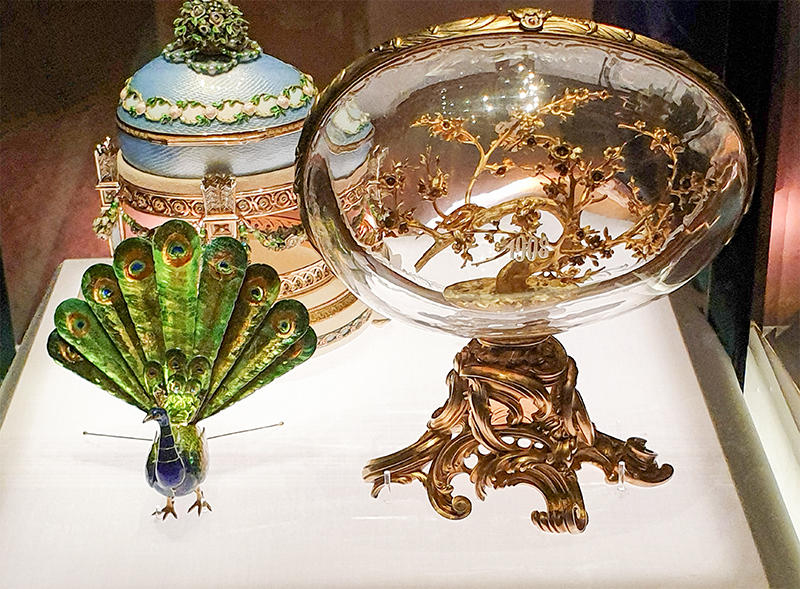
The Peacock Egg is among the most technically extraordinary of all Faberge’s creations – and one of the very few eggs held in a private Western European foundation rather than a museum or Russian collection. Made by Dorofeiev under the supervision of Faberge in 1908, it was a gift from Tsar Nicholas II to his mother, Dowager Empress Maria Feodorovna.
The egg is carved from rock crystal and placed horizontally, each half set into a heavy gold mount. Inside, a mechanical peacock sits amid the branches of a golden tree strewn with flowers of precious stones and enamel.
When removed from the egg and wound, the peacock walks, turns its head, and spreads its tail in a display of iridescent coloured enamel feathers. It is owned by the Foundation Edouard et Maurice Sandoz in Switzerland – which is why it is seldom seen at public exhibitions.
V&A note: The Peacock Egg is rarely on public display. We were fortunate to see it at a Faberge exhibition at the V&A Museum in London, and the working peacock automaton is genuinely one of the most astonishing things we have ever seen in a museum context. The level of mechanical engineering required to make a bird that size walk and spread its tail with such precision is almost impossible to comprehend.
Hidden surprise: A mechanical peacock automaton that walks, turns its head, and spreads its iridescent tail when wound.
Location: Foundation Edouard et Maurice Sandoz, Switzerland (rarely on public display).
11. The Alexander Palace Egg – Est. $7 Million
Made from Siberian nephrite – a deep green jade – set with gold, diamonds, and rubies, the Alexander Palace Egg was crafted by Henrik Wigström in 1908. The exterior bears watercolour miniature portraits of Nicholas II and Empress Alexandra’s five children in rose-cut diamond-bordered frames.
Inside you’ll find an intricate model of the palace and its gardens at Tsarskoye Selo – the family’s favourite residence. It is usually on display at the Kremlin Armoury in Moscow.
Hidden surprise: A miniature model of the Alexander Palace and gardens.
Location: Kremlin Armoury, Moscow.

12. The Gatchina Palace Egg – Est. $7 Million
Given by Tsar Nicholas II to his mother Dowager Empress Marie Feodorovna at Easter 1901, the Gatchina Palace Egg features several layers of translucent enamel applied onto mechanically engraved gold – a guilloché technique that creates a shimmering, watery effect beneath the enamel surface.
Inside there is a detailed replica of Gatchina Palace – the Empress’s winter residence. It is now part of the Fabergé Museum collection in St Petersburg.
Hidden surprise: A miniature gold replica of Gatchina Palace, complete with trees, cannons, and a statue of Paul I.
Location: Faberge Museum, St Petersburg.

13. Order of St George Egg – Est. $7 Million
Also known as the Cross of St. George Egg, this masterpiece was made in 1916 for Nicholas II of Russia. It was presented as a gift to his Mother, Dowager Empress Maria Feodorovna, during the First World War. Unlike most Imperial eggs, it was designed with wartime austerity in mind: there is no enamel and no precious stones. Instead, it is made from silver-gilt and opalescent white enamel in a relatively restrained design.
The egg commemorates the Order of St George – a military honour awarded to both Nicholas II and his son, the Tsarevich Alexei. Concealed inside are tiny watercolour portraits of the tsar and his son.
This historic egg is now part of the Fabergé Museum collection in St Petersburg, acquired by Viktor Vekselberg. Its value of around $7 million reflects its historic significance as the final Imperial egg as much as its materials.
Hidden surprise: Miniature watercolour portraits of Tsar Nicholas II and the Tsarevich Alexei.
Location: Faberge Museum, St Petersburg (Vekselberg collection).

14. The Hen Egg (First Imperial Egg) – Est. $6 Million
The Hen Egg is the first Fabergé Imperial egg ever made, commissioned by Tsar Alexander III in 1885. Its creation launched one of the greatest traditions in the history of jewellery. The design is deceptively simple: a white enamel shell opens to reveal a golden yolk, inside which sits a golden hen on golden straw. Originally inside the hen were a miniature diamond replica of the Imperial crown and a tiny ruby pendant – sadly both lost.
It cost 4,151 roubles. Six weeks after presenting it, Alexander III appointed Fabergé as official jeweller to the Imperial court. It is now at the Fabergé Museum in St Petersburg.
V&A note: Seeing the Hen Egg alongside the later masterpieces at the V&A was a fascinating exercise in following the evolution of Fabergé’s ambition. The first egg is modest by comparison to what followed – which makes it all the more interesting to stand before. You can see exactly why Alexander III was so delighted, and equally how quickly the subsequent commissions escalated in complexity.
Hidden surprise: A golden hen on golden straw (crown and pendant originally inside the hen are now lost).
Location: Faberge Museum, St Petersburg.

15. The Cradle with Garlands Egg – Est. $6 Million
Made by Chief Workmaster Henrik Wigström in 1907, the Cradle with Garlands Egg was commissioned by Tsar Nicholas II for his wife Alexandra upon the birth of their son Alexei. It is coated in pale blue enamel and encrusted with pearls. The surprise hidden inside – a miniature of the Imperial children – is now missing.
This egg has a particular connection to London: it was previously on long-term loan to the V&A Museum, where many visitors will have encountered it before its return to its private-collection owners.
V&A note: We saw the Cradle with Garlands Egg during the V&A exhibition period. It is one of the more intimate eggs – its pale blue colouring and pearl decoration give it a softness that the more jewel-encrusted examples don’t have, and the story of its creation to celebrate Alexei’s birth adds a poignant layer of context given what we know of the Romanov family’s fate.
Location: Private collection.

16. The Yusupov Clock Egg – Est. $6 Million
Crafted by Fabergé Chief Workmaster Henrik Wigström in 1907, the Yusupov Clock Egg was not made for the Imperial family but as a 25th wedding anniversary gift from Prince Felix Yusupov to his wife, Princess Zinaida. Made from gold, silver, gilt, diamonds, rubies, emeralds, pearls, white onyx and enamel, it is one of the most ornate non-Imperial commissions Fabergé ever produced.
The egg originally contained portraits of Felix and their two sons. The youngest son – also called Felix – later became one of the co-conspirators who murdered Grigory Rasputin in 1916. It is currently part of a private collection.
Location: Private collection.

17. The Tsarevich Egg – Est. $5-7 Million
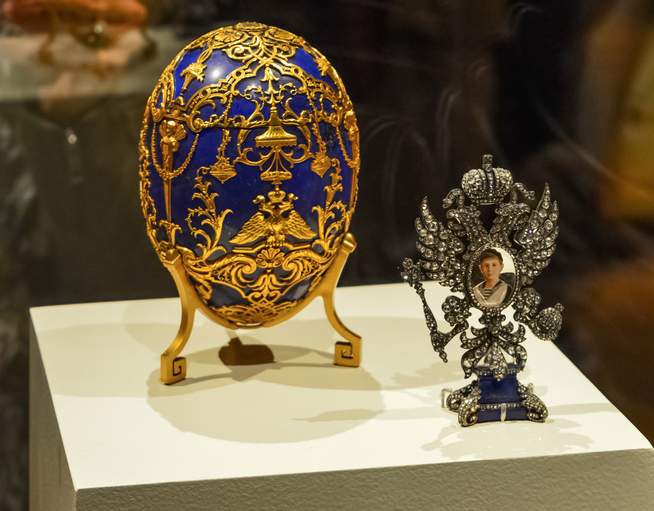
The Tsarevich Egg was crafted in 1912 by Mikhail Perkhin under the supervision of Faberge, and given by Empress Alexandra Feodorovna in tribute to her son, the Tsarevich Alexei. Its construction is unusual: the outer shell is made from six sections of carved lapis lazuli – the rich blue stone long associated with imperial Russia – separated by gold lattice work in the form of double-headed eagles and set with diamonds.
At the top of the egg sits a large flat portrait diamond, and the surprise is a miniature painting by Zuiev mounted in an ornate diamond-studded frame of a double-headed eagle design – a portrait of the Tsarevich Alexei himself. It is now on permanent display at the Virginia Museum of Fine Arts in Richmond, part of the Lillian Thomas Pratt collection.
Hidden surprise: A miniature portrait of the Tsarevich Alexei in a diamond-studded double-headed eagle frame.
Location: Virginia Museum of Fine Arts, Richmond, USA.
18. The Diamond Trellis Egg – Est. $4-5 Million
Originally costing 4,750 silver roubles, the Diamond Trellis Egg was created in 1892 for Tsar Alexander III as a gift for his wife, Empress Maria Feodorovna. Made from gold and the rare mineral jadeite – a vivid green jade – it is encrusted with rose-cut diamonds arranged in a delicate trellis pattern. It is usually on display at the Houston Museum of Natural Science.
Its surprise was long thought to be missing, but was subsequently identified in the Royal Collection – an ivory automaton elephant adorned with gold and precious stones. Its estimated value of $4-5 million reflects both its age as one of the earlier Imperial eggs and the exceptional rarity of jadeite as a construction material.
Hidden surprise: An ivory automaton elephant adorned with gold and precious stones.
Location: Houston Museum of Natural Science, Texas.

19. The Romanov Tercentenary Egg – Est. $4-5 Million
Created in 1913 to mark the 300th anniversary of the Romanov dynasty, the Romanov Tercentenary Egg is one of the most historically significant of all the Imperial eggs. Its outer shell is set with 1,115 rose-cut diamonds, and portrait miniatures of the eighteen Romanov rulers from Mikhail I in 1613 to Nicholas II himself are worked into the surface.
The egg is topped with a large diamond, and the surprise is a rotating globe showing the territories of the Russian Empire in both 1613 and 1913, mounted on a gold stand. It was given by Nicholas II to Empress Alexandra Feodorovna and is now on permanent display at the Kremlin Armoury Museum in Moscow.
Its relatively modest estimated value of $4-5 million reflects the difficulty of pricing an egg that has never come to public auction and is in institutional ownership.
Hidden surprise: A rotating globe showing the Russian Empire’s territories in 1613 and 1913.
Location: Kremlin Armoury Museum, Moscow.

20. The Bay Tree Egg – Est. $4-5 Million
The Bay Tree Egg is among the most enchanting automaton eggs ever made – a small gold tree hung with nephrite jade leaves, enamelled flowers, and fruits of precious stones, concealing one of Faberge’s finest mechanical surprises. When a hidden key is turned, a brightly coloured bird rises from the foliage, flaps its wings, moves its beak, and sings.
Made in 1911 and given by Nicholas II to his mother, Dowager Empress Maria Feodorovna, it was later sold by the Soviets alongside many other Imperial treasures. The singing bird mechanism requires extraordinary watchmaking precision. It is now part of the Vekselberg collection at the Faberge Museum in St Petersburg.
Hidden surprise: A singing bird automaton that rises from the foliage and performs when a hidden key is turned.
Location: Faberge Museum, St Petersburg (Vekselberg collection).

21. The Rosebud Egg – Est. $4 Million
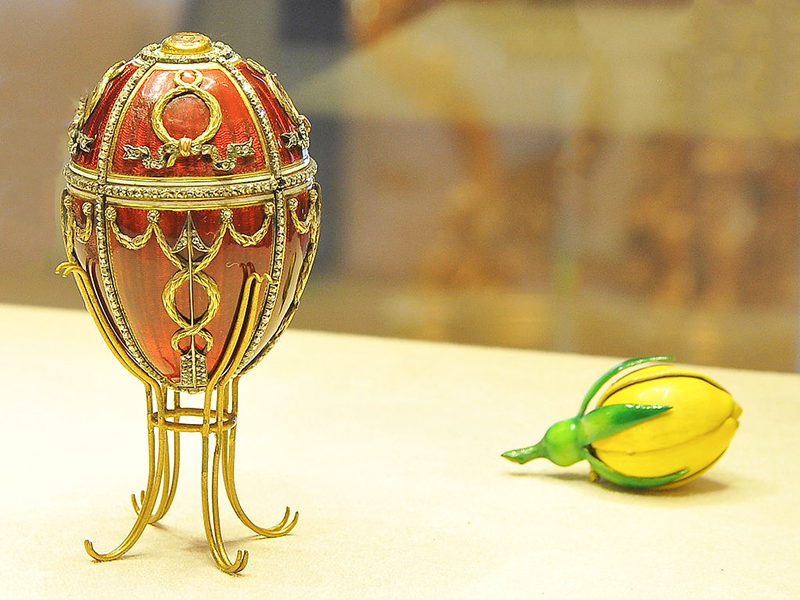
The Rosebud Egg holds a particular significance in the Imperial collection: it was the first Faberge egg that Tsar Nicholas II gave to his wife, Empress Alexandra Feodorovna, in 1895 – the first year of his reign. Red enamel covers the outer shell, with four bands of brilliant-cut diamonds running vertically around it. It was made by Michael Perchin.
The surprise is a yellow enamel tea rose, which originally contained two further surprises concealed within: a small diamond-set Imperial crown and a ruby pendant. Both the crown and the pendant are now missing, leaving only the rose.
Despite the absent interior pieces, the egg remains valued at around $4 million given its direct Imperial provenance and first-commission significance. It is now part of the Vekselberg collection at the Faberge Museum in St Petersburg.
Hidden surprise: A yellow enamel tea rose (originally containing a diamond crown and ruby pendant, both now lost).
Location: Faberge Museum, St Petersburg (Vekselberg collection).
22. The Blue Serpent Clock Egg – Est. $3-5 Million
The Blue Serpent Clock Egg is one of the earlier Imperial eggs, created in 1895 and notable for the serpent that winds around the clock face – a classical reference to time’s passage. The egg is set in pale blue enamel on a guilloche ground, with the serpent’s body serving as the clock hand.
It holds an interesting place in Faberge scholarship: until 2008 this egg was incorrectly believed to be the missing 1887 Third Imperial Easter Egg, before independent researchers established it as the 1895 egg – which eventually led to the rediscovery of the real Third Imperial Egg at a flea market in 2011. It is currently held in a private collection.
Location: Private collection.

23. The Basket of Flowers Egg – Est. $3-5 Million
The Basket of Flowers Egg is one of three Faberge Imperial eggs held in the Royal Collection. Made in 1901 and given by Tsar Nicholas II to his mother, Dowager Empress Maria Feodorovna, it is formed from white onyx with a basket-weave pattern set with diamonds. The surprise is an arrangement of enamelled flowers in a gold basket.
It was purchased by King George V and Queen Mary and has remained in the Royal Collection ever since, occasionally displayed at Royal Collection Trust exhibitions. Its relatively modest valuation reflects simpler materials compared to the more elaborate Imperial eggs – but its Royal Collection provenance ensures long-term cultural significance.
Hidden surprise: Enamelled flowers arranged in a gold basket.
Location: Royal Collection, UK.

24. The Imperial Red Cross Easter Egg – Est. $2-3 Million
The Imperial Red Cross Easter Egg is housed at the Cleveland Museum of Art and represents the wartime context of the final years of the Imperial tradition. Also known as the Red Cross with Triptych Egg, it dates from 1915 and is made from gold, silver, gilt, glass, ivory, and enamel.
Its relatively low valuation reflects the deliberate simplicity of its wartime design – there are no precious stones and minimal gold. The exterior bears a white enamel Red Cross on each face, and the inside reveals a triptych with portraits of five of the Imperial family’s charitable sisters.
Originally purchased for 3,600 roubles. Its significance is historical rather than material – a document of the last months before the Revolution.
Location: Cleveland Museum of Art, Ohio, USA.

How Much Is a Fabergé Egg Worth?
The short answer: between $6 million and $33 million for a confirmed Imperial egg, depending on provenance, condition, and auction history. The 2025 Winter Egg sale at $30.2 million is the most current public benchmark.
Several key factors determine value:
- Imperial vs non-Imperial: Eggs made for the Tsars command the highest prices. Non-Imperial commissions (Rothschild, Yusupov, Kelch) are valuable but typically lower.
- Completeness: Eggs with their original ‘surprises’ intact are worth significantly more than those where the interior piece is missing.
- Provenance: Clear, documented ownership history – especially direct Imperial provenance – adds substantial premium.
- Wartime simplicity: The final eggs made in 1915-16 (Order of St George, Red Cross) used fewer precious materials due to wartime austerity and are valued accordingly.
Where to See Fabergé Eggs In Person
The Fabergé Museum, St Petersburg
The Fabergé Museum holds the largest collection of Imperial Easter eggs in the world – nine of them, acquired by Viktor Vekselberg for approximately $100 million in 2004. It is the essential destination for any serious Fabergé enthusiast.
The Kremlin Armoury, Moscow
Ten Imperial eggs are held at the Kremlin Armoury, including the Alexander Palace Egg, the Gatchina Palace Egg, and the Moscow Kremlin Egg. On permanent public display.
The Royal Collection, UK
Three Imperial eggs are held in the Royal Collection – the Colonnade Egg, the Mosaic Egg, and the Basket of Flowers Egg. They appear occasionally in Royal Collection Trust exhibitions.
The V&A Museum, London
The V&A has hosted notable Fabergé exhibitions, during which many of the most famous eggs have been displayed together. We had the privilege of seeing a significant number of them in person during the V&A exhibition. If the museum mounts a future Fabergé exhibition, it is not to be missed.

Metropolitan Museum of Art
Visitors to the Metropolitan Museum of Art in New York can admire three Fabergé eggs which are on long term loan from the collection of philanthropist Matilda Geddings Gray. These are the Imperial Caucasus Egg, the Imperial Danish Palaces Egg and the Imperial Napoleonic Egg.
Other US Museums
There are two Imperial eggs at The Hillwood Estate, Museum & Gardens in Washington, D.C. – the Catherine the Great Egg and the Twelve Monograms Egg. Walters Art Museum in Baltimore also boasts two imperial eggs: the Gatchina Palace Egg and the Rose Trellis Egg.
The Cleveland Museum of Art houses one Imperial egg: the Red Cross Triptych Egg, and the Houston Museum of Natural Science has the Nobel Ice Egg on loan from its owners.

German Museums
The Fabergé Museum in Baden-Baden, Germany houses the Imperial Constellation Easter Egg, while the Liechtensteinisches Landes Museum owns the Apple Blossom Egg. And finally, several other Fabergé eggs are owned by private collectors.

Final Thoughts on the Most Expensive Fabergé Eggs
Fabergé eggs are among the most extraordinary objects ever created – not just as jewellery or craftsmanship, but as historical documents of a world that vanished in 1917. Having seen many of them in person at the V&A, we can say with conviction that no photograph or description fully prepares you for the reality. The scale of ambition, the impossibly fine detail, the mechanical surprises – it is something you feel rather than simply observe.
The 2025 Winter Egg sale, at $30.2 million, confirms what collectors have long understood: these objects are not simply expensive. They are irreplaceable.
Like this guide to the most expensive Fabergé eggs? Share it with friends.

Read Next:
Trending Products

OLEVS Automatic Watches for Men Bus...

Ferragamo Legacy Chronograph Watch

GUESS Stainless Steel Gold-Tone Cry...

Bulova Men’s Classic Sutton 4...

SEIKO Automatic Watch for Men ̵...

Stuhrling Original Mens Skeleton Au...
Bulova Men’s Marine Star Seri...

Stuhrling Original Mens Dress Watch...
Stuhrling Original Men’s Dive...
